Cavity Sliding Doors vs Hinged Doors in Australia:
Space, Noise, Cost & Best Room Choices

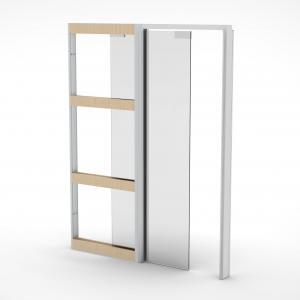
Premium125 SIngle Cavity system
Cavity Sliding Doors vs Hinged Doors in Australia:
Space, Noise, Cost & Best Room Choices
If you’re planning a renovation or new build in Australia, choosing between cavity sliding doors and traditional hinged doors directly affects
your space, privacy, and layout flexibility. This guide compares both options in terms of space saving, noise control, installation, cost, and best room-by-room choices so you can make a confident decision.
Quick Verdict:
- Choose a cavity sliding door if your priority is space, modern design, or a compact layout.
- Choose a hinged door if your priority is noise control, privacy, or better sealing.
In many Australian homes, the best solution is often a mix of both.
Quick definitions
What is a cavity sliding door?
A cavity sliding door (often called a pocket door) is a door that slides into a framed pocket inside the wall. When open, the door disappears into the wall cavity, leaving a clean, minimalist opening.
What is a hinged door?
A hinged door is the standard swing door that opens on hinges, requiring clearance for the door arc (“door swing”). It is the most common option in Australian homes because of its simplicity and strong sealing.
Space: the #1 difference
If you’re choosing doors for small rooms, tight hallways, ensuites, laundries, or open-plan layouts, this is where cavity sliders often win. A hinged door needs a swing zone, which can steal usable floor area and limit furniture placement.
- Hinged doors need clearance to open — this affects walkways, layouts, and furniture.
- Cavity sliding doors free up space — ideal for compact or highly-functional rooms.
In small Australian apartments, townhouses and narrow bathrooms, a hinged door can make a room feel cramped — while a cavity slider can make the same room feel noticeably larger.
Noise & Privacy: Which Door Is Better for Sound Control?
In most Australian homes, a well-installed hinged door usually provides better sound insulation than a standard cavity sliding door.
However, modern cavity sliding systems can achieve good acoustic performance when designed and installed correctly.
Why hinged doors usually win on sound control
A hinged door can close tighter, and it’s easier to add perimeter seals and threshold solutions.
This often results in better privacy, better noise reduction, and improved control of light and odours.
Why cavity sliders are typically less sound-isolating (and how to improve them)
Most cavity sliders have small perimeter gaps and don’t “compress” into seals the same way hinged doors do.
As a result, a typical cavity slider often provides less sound reduction than a comparable hinged door.
This does NOT mean cavity sliders are “bad” — it simply means they are better suited for space efficiency rather than maximum acoustic isolation.
How to improve acoustic performance for cavity sliders:
- Choose a heavier door leaf (solid core performs better than hollow core).
- Use a high-quality track/roller system.
- Consider compatible perimeter seals where possible.
- Add insulation inside the wall cavity.
Seal options vary by frame/system design — confirm compatibility before specifying.
Installation & renovation considerations
When hinged doors are easiest
- Quick door replacements
- Finished homes where you don’t want to open walls
- Walls that contain services (wiring/plumbing)
When cavity sliders make the most sense
- New builds
- Major renovations
- Tight or compact layouts
Can you retrofit a cavity slider into an existing wall?
Sometimes — depending on wall type, available cavity space, and whether services are inside the wall.
Many retrofits require opening the wall and installing a cavity frame.
For best results, cavity sliders should ideally be planned at the design stage with your architect or builder.
Best choice room-by-room
The right door choice depends on how you actually use each room in your home.
Below is a practical guide for typical Australian layouts.
Bathrooms & ensuites
- Cavity slider: great for tight spaces.
- Hinged: better if you want maximum sealing and privacy.
Bedrooms
- Hinged: usually best for noise control.
- Cavity slider: useful for wardrobes or tight layouts.
Wardrobes & laundries
- Cavity slider: excellent for space efficiency.
- Hinged: works but can block access in narrow rooms.
Home office / flexible rooms
- Cavity slider: ideal for zoning.
- Hinged: better if acoustic privacy is critical.
Kitchen–living (open-plan)
- Cavity slider: ideal for occasional separation.
- Hinged: less common due to swing space.
Final recommendation
If space, modern design, and flexibility are your priorities — choose a cavity sliding door.
If noise control, privacy, and sealing are your priorities — choose a hinged door.
In many homes, a smart mix of both delivers the best result.
Premium125 Cavity Sliding System
or contact us to discuss your project — we can help you choose the right solution before you build or renovate.
FAQ
Why Choose the Premium 125 Single Cavity Frame?
- Maximises usable floor space (saves up to 0.65 m² per room)
- Designed for Australian standard door sizes and wall systems
- Available in multiple configurations including telescopic and corner meeting
- Compatible with timber, aluminium and frameless glass doors
- Supports manual, soft-close and automatic operation
- Provides a clean, modern architectural finish
What is a cavity sliding door system?
A cavity sliding door system is a door that glides inside the wall cavity instead of swinging open. This allows you to save space and create a modern, clean interior look.
Why choose a Premium Sliding Doors cavity system?
Premium Sliding Doors provides durable aluminium frames, smooth rolling systems, soft-close options, and custom sizing for residential and architectural projects.
What wall thickness do I need for a cavity slider?
Our systems fit:
76mm stud walls (Only for Premium 125 system)
90mm stud walls
Custom configurations available for renovations and new builds.
Can cavity sliders be installed in existing homes?
Yes, cavity sliders can be installed in both new homes and renovations. Some walls may require partial opening for frame installation.
What type of doors can be used with premium cavity sliders?
Recommended Pairings Based on Door Type:
✔ Hollow core timber door → Premium 65
✔ Solid timber door → Premium 125 or Premium 150
✔ Tall custom doors (2400–3000mm) → Premium 150
✔ Aluminium-framed glass doors → Premium 125 or Premium 150
✔ Frameless glass doors (10–12mm) → Premium 125 or Premium 150
Do you offer soft-close and soft-open options?
Yes — we supply premium soft-close mechanisms for smooth and controlled door movement. Soft-open available on selected systems.